Legged robots
A quadruped or a humanoid is, to the cell, a vehicle
with legs. It is sent with goto, it arrives with device_done, it carries
what sits on its back or in its hands, and it has to fit through the gate
like any AGV. What the vehicle vocabulary lacks is the legs — and that is
all bt.Gait adds: which links are the feet, how the machine stands, and
the rhythm it walks to.
dog = bt.Robot.from_urdf("go2.urdf")
gait = bt.Gait(
    legs={"FL": "FL_foot", "FR": "FR_foot", "RL": "RL_foot", "RR": "RR_foot"},
    stance={"FL_hip_joint": 0.0, "FL_thigh_joint": 0.8, "FL_calf_joint": -1.5, ...},
    pattern="trot", period=0.45, lift=0.07, max_stride=0.45, foot_radius=0.022,
)
scene.add_robot(dog, name="go2")
scene.add_vehicle("walker", body=["go2/footprint"], path=[YARD, DOCK, BAY],
                  stations={"yard": 0, "dock": 1, "bay": 2}, speed=0.6, turn_speed=1.0)
scene.mount_robot("walker", robot="go2", gait=gait)   # stands it on the floor

sq.step("to dock", actions=[bt.seq.goto("walker", "dock")],
        transition=bt.seq.device_done("walker"))
The goto is what makes it walk. There is no walk action to author, any
more than there is a "spin the wheels" action for an AMR: the legs are a
property of the mount, the way a wheel's spin is a property of its axle.
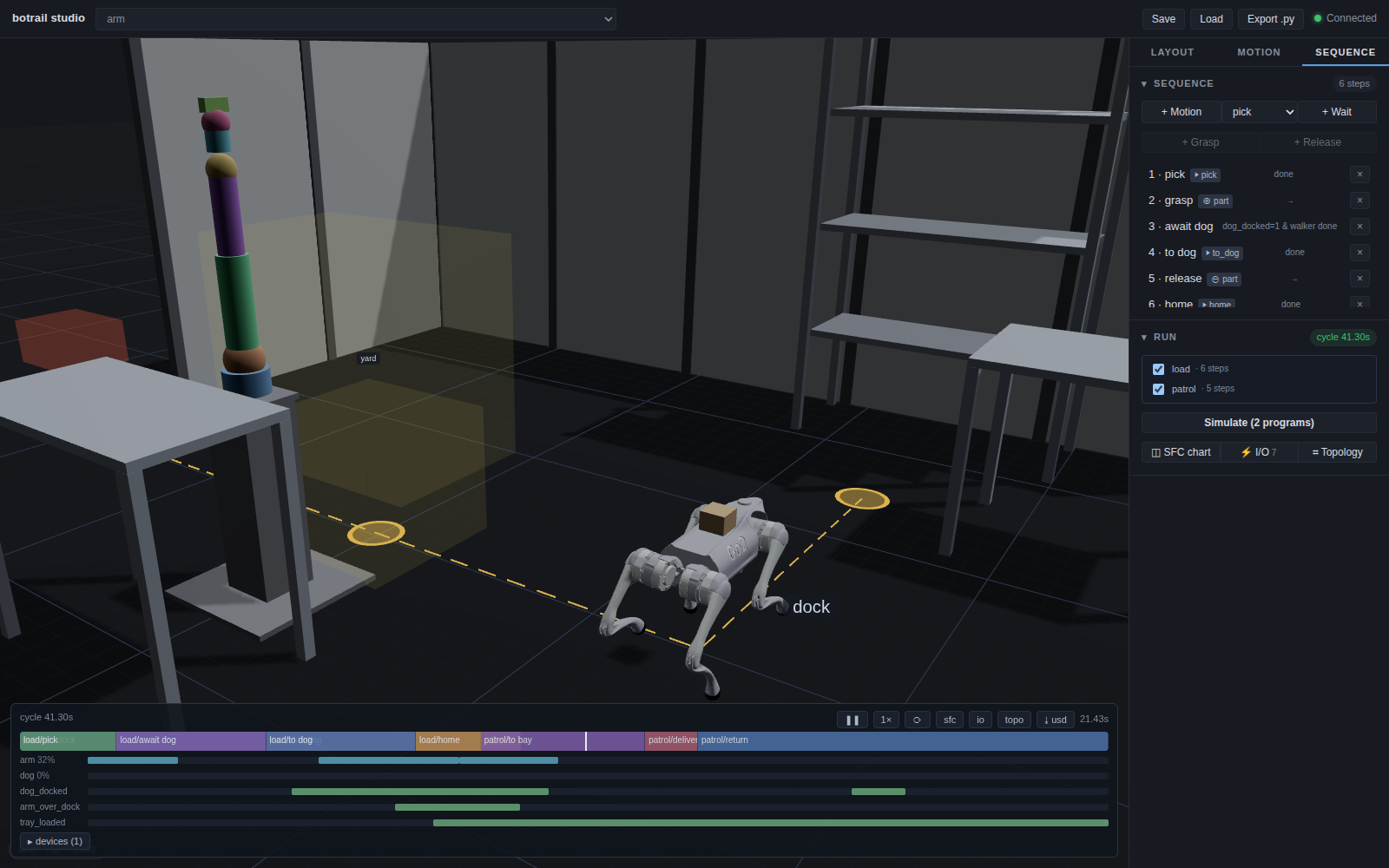
What is simulated, and what is not
Nothing physical. The body rides the vehicle's closed-form motion — a straight at constant speed, a pivot at constant rate — exactly as an AMR's base does. The moment the vehicle is dispatched, every footfall of the drive is planned from that motion: a foot lands where its stance will be centred under the body at mid-stance (a half-stance ahead on a straight, a step around the origin on a pivot). From then on a planted foot never moves in the world, and each leg is solved by IK every scan tick to keep it there. After the vehicle stops the footfalls converge on the parked positions by themselves, so the machine settles into its stance within a cycle or so of arriving.
The one thing that makes a walk look wrong is a foot that slides. That is the one thing this guarantees — and it is checked, not hoped for: the feet on a baked timeline stay within a micrometre of their landings.
What it does not answer is whether the machine could actually walk:
- No balance, no contact forces, no slip, no falling over.
- Floors follow the vehicle's path: a ramp is walkable when its waypoints
climb (declare
max_grade— see vehicles), and steps are walkable where a walkable surface stands (a stair tread, a mezzanine slab — see Stairs and steps). What the feet do on them is placement, not physics: no balance there either. - No acceleration — vehicles move at constant speed, legged or not.
- A leg's reach is checked (a stride the legs cannot take is refused by name, before or during the bake), its torque is not.
What it does answer is what it answers for any vehicle — does it fit, does it clash, how long is the cycle — with legs that move like legs.
The gait
| Field | Meaning |
|---|---|
legs |
Leg name → foot link, in the order the pattern's phase table is read: FL, FR, RL, RR for the quadruped patterns, L, R for biped. A value may be (foot_link, contact) to give one leg its own contact. |
stance |
Joint → value of the standing pose. Must name every leg joint; other joints keep their mount-time value. The feet must stand level (on one plane within 5 mm). |
pattern |
walk (duty 0.75, lateral sequence), trot (duty 0.5, diagonal pairs), biped (duty 0.6), or custom with duty and phases. |
period, lift |
Cycle time in seconds; swing apex above the floor in metres. |
max_stride |
The longest step a leg may take between two landings. speed × period (and the outer foot's arc in a pivot) must stay under it, or the vehicle's rates are refused by name. |
foot_radius |
How far the foot link's origin stands above the floor: a ball foot's radius, or an ankle frame's height over its sole. |
contact |
point (a ball: position only) or sole (flat on the floor, pointing where it landed). A sole's foot link must point +Z up in the stance; a 6-DOF leg keeps it flat and pointed, a 5-DOF leg keeps it flat. |
arm_swing |
Joint → amplitude swung in step with the first leg — a biped's arms. Left alone while the robot holds something or a ramp is driving them. |
bob, lateral |
Body sway while walking: up and down twice a cycle, over the planted leg once a cycle. The legs absorb it; the feet do not move. |
Mounting with a gait stands the robot on the vehicle plane (the offset is
derived from the stance; pass offset_position to override) and puts it
into its stance. Standing, the legs are yours to ramp — a crouch is a ramp
like any other — but a leg joint cannot be ramped mid-walk, and a walk
cannot start while a ramp is still moving a leg. Planned motions cannot
start while the vehicle drives, for the same reason as on an AMR: a plan
is baked in world coordinates.
The body, the aisle, and the load
The vehicle's body is the aisle check. A legged robot's links are a
robot, not a body, so give the vehicle an invisible footprint box —
set_obstacle_visible(name, False) — sized to the machine; a gate too
narrow for it fails with VehicleCollision naming the panel. Mounting with
a gait marks the robot's links as allowed to touch that footprint (it
stands inside it), so it never counts as a collision.
The legs themselves are checked too, while the vehicle moves: a link or a
held part that meets the environment fails with RiderCollision, naming
the link and the obstacle. This is the same check an AMR's arm gets while
its carrier drives.
Anything set down inside the vehicle's tray rides along — a part placed
on a quadruped's back by an arm is cargo the moment it is released, with no
load action. A humanoid carries in its hands: attach the part to a hand
link, and it rides still through the walk (the arms do not swing with full
hands).
A walking machine's deck is its body. On a wheeled vehicle the tray is rigid with the route, and the two are the same thing; on a legged one they are not — the body tilts onto a grade and rides up the steps while the route stays on the guide line between the waypoints. So the zone is placed on the body and what it holds is bound to the body link, which is what a strap does: on a flight the load climbs and tilts with the back it sits on, instead of floating a ride's worth above it. Everything downstream — the studio, the USD bake, the collision checks — reads that pose, so no authoring changes.
Humanoids
Two legs, soles instead of balls, arms that swing, a body that bobs:
g1 = bt.Robot.from_urdf("g1_29dof_rev_1_0.urdf")
gait = bt.Gait(
    legs={"L": "left_ankle_roll_link", "R": "right_ankle_roll_link"}, contact="sole",
    stance={...}, pattern="biped", period=0.85, lift=0.05, max_stride=0.5,
    foot_radius=0.035,                     # the ankle frame sits 35 mm over the sole
    arm_swing={"left_shoulder_pitch_joint": -0.25, "right_shoulder_pitch_joint": 0.25},
    bob=0.015, lateral=0.02,
)
Two things worth knowing before you teach one:
- Bend the knees. A leg stood nearly straight has no reach left for the foot that stays planted while the body moves off — the first half-period of every walk stretches it by half a stride. A stance with the knees at 0.8 rad walks where one at 0.5 rad fails by name.
- Arm ramps are not planned. A ramp from "arms at the sides" to "arms
forward" swings the forearms through a bench at hip height, even though
both end poses are clear. Teach an intermediate pose (out and up, then
in), and check every ramp the way
examples/legged/humanoid_carry_demo.pydoes: sample it and askcheck_collisions()— the demo refuses to bake a ramp that sweeps through the cell.
Crouching
Standing, a humanoid's hands reach only so low: a waist that pitches a
fraction of a radian leaves a box on the floor, or the bottom shelf of a
cage trolley, out of reach. bt.seq.crouch lowers the body while the
machine stands — its feet stay where they are, and every leg is re-solved
each scan tick by the same leg IK the walk uses:
sq.step("go", actions=[bt.seq.goto("legs", "cage")], transition=bt.seq.device_done("legs"))
sq.step("down", actions=[bt.seq.crouch("h2", 0.35, lean=0.3)])   # 0.35 m down, 0.3 rad forward
sq.step("place", actions=[bt.seq.ramp(place_pose, 1.2, robot="h2", check=True)])
sq.step("up", actions=[bt.seq.crouch("h2", 0.0)])                  # stand back up
depthis metres below the standing height,leana nose-down pitch of the body (radians) about its own lateral axis — the forward lean of a real squat. A crouch goes from the posture it finds to the one asked, on a smoothstep;durationdefaults to a pace (0.3 m/s, 0.6 rad/s). It is a move: the step waits for it, and so doesrobot_done.- The whole crouch is priced when the step fires: a leg that cannot keep its foot planted fails the bake by name, with the depth asked. On the way down the robot — legs, body, what it holds — is checked against the cell every tick, like a rider (the knees meet the trolley; the held box meets the shelf it is lowered past).
- Fired the scan the walk arrives, a crouch waits for the last foot to
land. While the body is lowered the vehicle does not drive: a
gotois refused untilcrouch(robot, 0)has stood it up, and a planned motion waits for the crouch to finish. Ramps may run alongside it; withcheck=Trueeach point of the ramp is held where the body will be. scene.crouch_pose(depth, lean=, robot=)returns the crouched posture —(base_pose, joints)— where the robot stands now, without changing the scene: set it withset_robot_base_pose/set_joint_positionsand solve the arms there, and the pose is the one the bake reaches.- Nothing balances: the bake does not ask whether the machine would tip
over squatting with a load held out front. Neither does it check the
legs against each other — a coarse collision model can fold a shank into
a foot at a deep crouch, which a checked ramp or a plan then reports as
the robot touching itself; declare such pairs with
Robot.allow_collisionsif the real machine folds that far.
examples/legged/gtp_station_demo.py puts this to work: a Unitree H2 at a
goods-to-person station crouches to take cartons from an AGV's rack and to
set them low into a roll cage, every pose taught at its crouch with
crouch_pose and every crouch baked with crouch.
From the catalog
A legged machine in the catalog is a vehicle.legged package, and its
manifest carries the gait: which links are the feet, the stance it
stands in, the rhythm it was validated to walk with (the catalog builder
stands every such package on its stance and walks it through a pivot
before it ships). Gait.from_catalog reads that block, so a cell copies
no joint name out of a URDF:
dog = bt.Robot.from_catalog("unitree/go2/go2")
gait = bt.Gait.from_catalog("unitree/go2/go2", period=0.5)   # keywords override
scene.add_robot(dog, name="go2")
scene.mount_robot("walker", robot="go2", gait=gait)
A package directory on disk works the same way — bt.Gait.from_catalog(
"build/unitree/go2/go2/r1") reads the manifest.yaml a local bcb build
wrote — and a package that is not legged is refused by name. Beside the
gait, the manifest's specs say what the cell needs to size the body the
gate sees (footprint_mm, height_mm) and cap the vehicle's speed
(max_speed_mps); examples/legged/legged_patrol_demo.py --compare bakes one
cell on every package named and tables which fit and how long they take.
A wheel-legged package (unitree/go2/go2-w, unitree/b2/b2-w) keeps the
same block and adds wheels to it: bt.Wheels.rolls(package) says so, and
bt.Wheels.from_catalog gives the wheels to mount beside the gait —
mode="auto", the wheels' rated max_step_mm, and specs.max_speed_mps
now the rolling speed a cell derates for its vehicle. The gait's
foothold_m (a wheel's contact patch) and gait.speed_mps (the pace it
walks the flights at) ride along in the Gait:
dog = bt.Robot.from_catalog("unitree/go2/go2-w")
gait = bt.Gait.from_catalog("unitree/go2/go2-w", posture="stairs")
wheels = bt.Wheels.from_catalog("unitree/go2/go2-w")          # mode="auto"
scene.add_vehicle("dog", ..., speed=1.5)                       # 60 % of the 2.5 m/s it rolls at
scene.mount_robot("dog", robot="go2w", gait=gait, wheels=wheels)
Stairs and steps
A staircase is authored as geometry, not as a special move: mark an
upright box's top face walkable (scene.set_obstacle_walkable(name)) and
footfalls snap onto it. bt.parts.stairs builds a whole flight that way —
every tread a walkable box, stringers, legs and the handrail ordinary
obstacles — with the frames <name>/foot and <name>/top to author the
guide path's z between (the path climbs as a slope; the feet land on the
treads it interpolates past). catalog= orders the flight instead of
drawing it, and the sizes then come from what the maker sells. The swing
clears the higher tread by the authored lift automatically.
The body rides the steps, not the guide line. Two things happen to it on a flight, and both are about reach rather than looks:
- it pitches to the grade of the path under it (blended over one body length so nothing snaps, level again when it parks) — a level body asks its downhill legs for half a machine-length of slope below the hips, which is more than a real leg has;
- it rises with the feet — the height it holds follows where its feet actually are (a swinging foot counts along its arc, so the body glides rather than steps), instead of holding one height over the straight line the route draws. Without it a single stance has to serve both extremes at once: a leg reaching down to a low tread while another folds up under a high one.
Together they roughly double the riser a given machine can take. Wheeled vehicles are unchanged — their bodies stay level.
Take the stair posture. A machine walks a flight lower than it stands, and picks its feet up less. Those two numbers decide the riser it can take at all, they belong to the machine, and a package that has been measured on a flight carries them:
bt.Gait.postures(package) says whether there is one — ("stairs",) or
() — so a cell that can do either asks first rather than handling a
refusal. Asking for a posture a package does not carry is refused by name;
the cell then states the stance and lift itself
(bt.Gait.from_catalog(..., stance=…, lift=…)). For a Go2 on a 150 mm
riser that is roughly 0.25 m of stance depth (against 0.311 standing) and
a 15 mm swing. Get it wrong and the bake says so, with the distance the
leg was short by.
Stating it yourself, what is worth writing down is the depth, not the
joint angles: which fold puts a foot 0.25 m under the body depends on the
legs, and a standing stance is rarely a clean one to scale (the Go2's is
thigh 0.8 / calf −1.5, its foot 0.178 m ahead of the hip). That is why the
angles live in the package, which knows the legs.
examples/legged/stairs_delivery_demo.py does both: it asks the package for the
posture, and where there is none it solves the fold by standing a scratch
copy of the machine and reading a foot — so the same cell posture-fits
whatever walks it, and the primitive quad_test.urdf, having shorter legs,
is told to take a lower flight.
Walkable excuses exactly one thing: the machine walking on it. Its own aisle check and its rider check treat treads the way no one collision-checks a floor against the machine standing on it — while an AGV driven into the flight, or an arm sweeping through it, still collides by name.
Two checks come with the terrain, both at dispatch, both naming the offender:
- Step height —
bt.Gait(max_step=...)declares the tallest rise one leg may take (a catalog package fills it frommax_step_height_mm). A flight over the ability is refused with the leg and both numbers; without a declaration the IK (GaitReach) is the backstop. - Tread edges — a foothold closer to a tread's edge than the foot radius is refused with the tread's name and the margin, before anything walks half-on, half-off a step.
Wheels for feet
A wheel-legged quadruped — a Unitree Go2-W or B2-W, a wheel where each foot
was — is mounted with a bt.Gait and a bt.Wheels. The gait's feet are
the axle frames the wheels turn on (a frame fixed to each calf at the wheel
joint's origin; a catalog package carries it, a plain URDF gets it from an
extra fixed link), its foot_radius is the wheel's radius, and the wheel
joints belong to the wheels, so neither gear knows the other is there. The
wheels' mode says which one takes the route:
gait = bt.Gait(legs={"FL": "FL_axle", "FR": "FR_axle", "RL": "RL_axle", "RR": "RR_axle"},
               stance=..., pattern="trot", period=0.45, max_stride=0.45,
               foot_radius=0.086, foothold=0.02, speed=0.4)
wheels = bt.Wheels({"FL_foot_joint": 0.086, "FR_foot_joint": 0.086,
                    "RL_foot_joint": 0.086, "RR_foot_joint": 0.086}, drive="skid")
scene.add_vehicle("dog", body=["dog/footprint"], path=..., speed=1.5, max_grade=0.4, ...)
scene.mount_robot("dog", robot="go2w", gait=gait, wheels=wheels)
tl = seq.simulate()
tl.locomotion("go2w")     # [(t0, t1, "roll" | "walk", metres), ...]
mode="auto"(the default) decides leg by leg of every route from the floor under it. Along each straight the supporting surface — a walkable face, else the guide line — is read every wheel radius; a jump taller than the wheels'max_step(a stair flight, a kerb) makes the leg a walked one, the rest are rolled. The walk reaches from a wheel's leading edge before the first step (rolling into a kerb is what the walk is for) to a hind foot's last landing past the last one — the straights either side are split there, or walked whole when what would be left to roll is shorter than two machine lengths or than the time the legs take to change gear. A turn is walked when either straight beside it is. Rolled legs go at the vehicle'sspeedandturn_speed; walked ones at the gait'sspeedandturn_speed(by default the stride-safe0.6 · max_stride / period, never faster than the vehicle). The gait's stride check is made against the walked pace.mode="roll"— every route is rolled: the legs hold the posture the machine was mounted in (the gait's stance, with the wheels'posturelaid over it), every wheel turns by exactly its hub's travel, and a step on the route is refused by name (RollStep, with the rise and where). A pivot is a skid turn — the wheels on the inside roll backward.mode="walk"— the wheels are locked and the machine walks on them as on feet everywhere, wheel radius for foot radius: the same footfalls, checks and stairs as the legged machine it also is.
Where a route changes gear nothing stops: a planted axle simply starts rolling with the body when its walk ends, a swing still in the air lands under its hip, and each leg then blends into the stance over a second as the wheels turn under it — by the hub's travel through the body as well as the vehicle's. Where a roll ends and a walk begins, the wheels lock where they stand and the first swings are taken from there. A rolled route dispatched while the legs were still settling from a walk rides them into the stance the same way.
The mount is checked as one machine: one wheel hanging from every foot
link, the foot frame on the axle (within a millimetre), the radius and
foot_radius one number, the axles level and the hubs on one floor in the
stance — each named when it is not so. The bill of materials has one line
for it, and its wheel joints are the mount's: no motion or ramp may drive
them in any mode.
A wheel is not a ball: it touches a tread at a point. Gait.foothold is
the tread margin a foothold needs — by default foot_radius, a ball
foot's; a wheel-legged machine states its contact patch (20 mm), or the
step check would ask 86 mm of tread on either side of every landing.
Reading the bake
timeline.footfalls(robot) lists every step as (leg, lift, land,
(x, y, z)); timeline.base_pose(t, robot) carries the body's sway. The
cycle time is the vehicle's: walking costs no time over driving, which is
to say a legged robot is budgeted like any other vehicle, by its path and
its speed.
Script export (to_script, export_script) refuses a walking robot — its
joints are its legs, and no controller takes a gait as a program. The cycle
belongs to the PLC side (export_plcopen), where the vehicle is a device
like any other.
Examples
examples/legged/legged_patrol_demo.py— a Unitree Go2 (the catalog packageunitree/go2/go2when it is reachable, else Unitree's URDF with the meshes converted on first run) walks in through a gate, docks, has a part placed on its back by an arm, and carries it to the bay.--robot <dir>runs it on a package the catalog builder wrote,--robot quadon the primitive quadruped inexamples/assets/quad_test.urdfwith no download;--narrowshows the gate check failing;--compare <dir> ...tables every candidate.--robot go2wis the Go2-W, wheels for feet: the walkway is flat, so--mode autorolls it at 1.5 m/s and the cycle is 23.1 s against the Go2's 41.3 s;--mode walklocks the wheels and takes the Go2's 282 steps in the Go2's time.--robot quadwisexamples/assets/quad_wheel_test.urdf, the offline wheeled stand-in the tests use.examples/legged/humanoid_carry_demo.py— a Unitree G1 picks a tote off a bench, carries it to another, sets it down and walks back.--robot bipedruns it onexamples/assets/biped_test.urdf.examples/legged/stairs_delivery_demo.py— a quadruped carries a tote up abt.parts.stairsflight to a mezzanine: footfalls on the treads, the body on the slope.--tallraises the risers over the gait'smax_stepand shows the refusal, named.examples/legged/building_delivery_demo.py— the same machine delivering through a whole building (--robot go2w: the Go2-W rolls the corridors and walks the flights, 54 s a storey against the Go2's 87 s, and the bake says what it rolled and what it walked): B1F 荷受け to 5F, switchback flights and 2.40 m corridors, with a lift that is in the cell and never called.--codeorders the flight a person's building is built to and the bake refuses it for the dog's rating;--cartleaves a cleaning cart across the corridor. The building isbt.parts.wallandbt.parts.stairs, and the stair sets the storey — order a different riser and the floors move.examples/legged/wash_inspect_ship_demo.py— a catalog Unitree G1 works a finishing line by hand: four stations on a ring walk, one taught set of right-arm reaches planned at every station (define_groupon the arm, the fingertips' reach measured off the model, the START press calibrated against the button's zone), the bath and the inspector on their own controllers, the camera's verdict latched and branching, and the whole hand-over set. A move started the moment a walk ends is the arm's: the gait swings an arm only while the vehicle moves, and lets go on arrival.