The I/O map
A cell that bakes is not yet a cell that can be built. Between the two sits the electrical face of the cell — which signals become which inputs and outputs on which controller, how many points that is, and where the handshakes run. botrail derives that list from the cell you already authored; there is nothing extra to write.
scene.io_points()                  # the points, one per wire the cell needs
scene.io_report()                  # findings: unbound points, clashes, ...
scene.export_io_list("cell_io.csv")   # .csv / .md / .json
scene.auto_assign_io()             # put every unbound point on a free channel
scene.export_topology("cell.mmd")  # who wires to whom — .mmd / .dot / .json
The points are derived, not stored: call again after any edit and the list follows. What it derives is decided by how the sequences use the scene's names — the same rule that gives a PLC its I/O list from its ladder. What is stored is the assignment layer: which controller runs which program, and which channel each point lands on (see Nodes and bindings below).
The map is the signal side. What a piece of equipment draws — power from which supply, air from which valve — is declared separately as equipment connections; a signal port there can point at a point of this map.
How points are derived
| The cell says | The map lists | Rule |
|---|---|---|
a Zone / Beam sensor |
a DI on every host that reads it (or one unhosted DI if nobody does — the sensor still exists) | ① |
an internal signal that one program sets and another program on a different controller reads |
a handshake wire: a DO on the writer's host, a DI on each other reader's host (one output fanning out to N inputs) | ② |
| an internal signal written and read on one controller | an internal relay — listed, but not I/O | ② |
an internal signal that is only ever set |
a DO candidate — an actuator coil (vacuum, gun_on, spindle_run) or a state flag; you decide which by binding it or not |
③ |
| an internal signal that is only ever read | a DI candidate — an external contact (a gauge verdict, a selector switch, an E-stop healthy signal) | ④ |
a device commanded start/stop |
a DO run coil; advance → name.index DO; goto → name.dispatch DO + name.station Word; move_to → name.position Word; set_speed → name.speed AO |
⑤ |
a device awaited with device_done |
a DI (in position / arrived) | ⑤ |
a linear axis with named stops |
a DI per stop, <axis>/<stop> — the limit switch at that end, read like a sensor |
⑤ |
a Source / Sink magazine |
a cosmetic row — presentation, not counted, not linted | ⑤ |
a robot driven (motion / ramp / toolpath) by a program that does not live on that robot's own controller |
robot.start DO + robot.done DI on the driving host; a robot.program Word when the program picks among several motions |
⑥ |
a program that only reads robot_done("x") from another host |
x.done DI on the reader's host |
⑥ |
Word and AO points are table vocabulary — the numeric commands a bool coil
cannot carry. They are listed (and flagged word_unexpressible, an info),
and the URScript lowering keeps them as comments, as it does today.
Hosts: who owns a point
Every point belongs to a host, the controller that owns it. Until a node
declares one (programs=, below), hosts are implicit and follow the same
rule the URScript export uses:
- a program that drives exactly one robot lives on that robot's own
controller — shown as
<robot name>; - a program that drives none or several lives on the implicit cell
controller — shown as
<cell>(animplicit_hostinfo names it).
That is why the single-arm demos show no robot handshake at all (the robot
runs its own program, like the URScript it exports), while a two-arm program
grows near.start / near.done / far.start / far.done on <cell> — the
PLC-master view of the same cell, with nothing declared. Reader hosts split
points: a signal read from two controllers is two inputs and one wire.
Declaring nodes (programs=) moves programs between hosts, and binding
points to channels is what turns the list into wiring — the next section.
Nodes and bindings
The assignment layer has three parts, all stored on the scene and in the
.botrail project:
# controllers and I/O stations — the boxes
scene.add_io_node("PLC1", kind="plc", programs=["transfer"],
                  channels=bt.io.di16(base="%IX0.0") + bt.io.do16(base="%QX0.0"))
scene.add_io_node("RIO1", kind="remote_io", uplink=("PLC1", "PROFINET"),
                  channels=bt.io.di8(base="%IX1.0"), model="ET200SP", place="panel")
scene.add_io_node("UR", kind="robot_controller", robots=["arm"],
                  channels=bt.io.ur_standard())

# point → channel — one wire per controller
scene.bind_input("beam_pick", "RIO1", "DI2", tag="PartAtPick", field="-B1")
scene.bind_output("conv", "PLC1", "DO0", tag="BeltRun", field="VFD1")
scene.bind_output("vacuum", "UR", "DO1", field="YV1", invert=True)   # NC wiring
scene.bind_input("far.done", "PLC1", "DI4")                          # a robot's done contact

# exceptions to the derivation, and unmodelled points
scene.declare_io("spec_ok", role="internal")                         # a constant, not a contact
scene.declare_io("door_ch1", role="input", kind="safe_di", safety=True, pair="door_ch2")
- Nodes are
plc,safety_plc,remote_io,robot_controller(withrobots=[...]— a two-arm cabinet lists both) orother(documentation only). An arm nobody has declared a cabinet for still has one on the BOM — the derived line<robot>/controller— and its points land on the implicit host<robot>; declaring the node gives that cabinet its channels, a model and a place (bt.parts.controllerdeclares it together with the box it stands in).programs=places sequences on a node and overrides the implicit hosting;uplink=hangs a remote station or a safety module off a controller — its channels then take that controller's points.channels=is a list of dicts; thebt.iotemplates build them (di8/do8/di16/do16(base=…),safe_di8,word,ao,ur_standard()), a catalog product brings its own (bt.io.from_catalog("universal_robots/ur/ur5e/r2")reads the package'selectrical.io— the controller's channel table, or the template it names;bt.parts.remote_io(catalog=…)builds a station's node the same way), and address dialects live there, in Python:base="%IX0.0"counts byte.bit (IEC; SiemensI0.0/Q0.0the same way,bt.io.siemens("di", 16)),bt.io.melsec("di", 16, "X10")counts hex for the Q / iQ-R series (octal=Truefor FX:X10 … X17, X20),bt.io.logix("di", 16)a flat Logix bit index (Local:1:I.Data.0 … .15), andbt.io.address(base, n, radix, word_bits)is the counter behind them all. - Bindings key on
(point, node).nameis the point's label —"conv","line.index","far.done".invertis the wire polarity: the bake is untouched, the URScript export tests and writes the opposite level.contact("no"/"nc"),field,voltage,logic("pnp"/"npn"),notedocument the far end. - Declarations override the derivation for one name —
"input","output"(also promotes a magazine to a real feeder),"internal","exclude"— and add unmodelled points (a safety door's two channels) that exist on the drawing but not in the simulation.
Once nodes exist, the derivation places programs on them (a program that drives a robot whose controller is a declared node lives there), matches bindings to points, and the report gains the assignment lints:
| code | severity | meaning |
|---|---|---|
unbound |
error / warning / info | a point without a channel: error for sensors the sequences read, run coils, in-position inputs, robot start/done, handshake wires; warning for candidates (write-only / read-only signals, unread sensors); info for Word/AO |
duplicate |
error | two points on one channel; two channels of a node with the same address or tag |
kind |
error | an input bound to a DO channel, a word to a DI, ... |
host_mismatch |
error | a binding on a node that does not reach the point's host (bind it there, or uplink the node) |
stale_binding |
warning | a binding whose point is no longer derived — the sequences stopped using the name that way |
unknown_ref |
error | a node listing a program that is not a sequence, a robot not in the scene, an uplink to nothing; a declaration naming nothing |
program_multihost |
error | one program listed by two nodes |
Before any node is declared nothing is being assigned, so unbound stays
quiet — the I0 lists of the shipped demos are clean. assert
scene.io_report().errors() == [] is the CI form once the wiring is meant
to be complete.
Scripts follow the bindings
to_script / export_script (on a timeline or a scenario sweep) project
the bindings on the robot-controller node onto the script's digital ports
— channel.port is the vendor number set_standard_digital_out(...)
takes — so the inputs= / outputs= dicts become optional. Explicit
dicts still win, per key; node= picks another node; io=scene.io_map()
projects the scene's current assignment onto a timeline baked before
you wired it (a timeline carries the scene as it was when it baked).
Two things changed under the hood: an inverted binding inverts every
test and write of that point in the script, and a program's robot_done
on its own robot lowers to nothing — a blocking controller is idle
there by construction, so it needs no input port any more.
The program set
The walk covers every sequence in the scene by default. A scene that keeps
alternative programs side by side (the two-arm demo has dual_pick and an
interlock-free clash) reads differently per set, so name the programs you
would pass to simulate_sequences:
Reading a point
label—nameorname.aspect(line.index,agv.station,far.done).direction—"input"/"output", from the host's side.kind—"DI","DO","Word","AO", ...source— the rule that produced it:sensor,signal:handshake,signal:internal,signal:write-only,signal:read-only,device:run,device:done,device:command,device:cosmetic,robot:start,robot:done,robot:program.writers/readers—(sequence, flat step index, step name)of the steps that drive or wait on it (the same step keys the timing chart uses).status—bound,unbound(needs a channel),internal,cosmetic, orconstant(a belt that runs from t = 0 and is never commanded: the drive exists, wired on).
Findings
scene.io_report() returns findings with a severity, a code and the steps
they belong to. The derivation's own codes:
| code | severity | meaning |
|---|---|---|
name_clash |
warning | a name shared by two of signal / sensor / device / robot, or a signal name containing . (it reads like name.aspect) |
unreferenced |
info | a signal or device that no program touches |
word_unexpressible |
info | a Word / AO point — in the table, not on a bool channel |
implicit_host |
info | a program that landed on <cell> (drives none or several robots) |
report = scene.io_report()
assert report.errors() == []          # the CI form (nothing errors yet — see below)
for f in report.warnings():
    print(f.code, f.message, f.at)
The assignment codes are listed under Nodes and bindings.
Once channels carry electrical data (voltage, logic) and points carry
safety, the report also checks the wire against the terminal:
| code | severity | meaning |
|---|---|---|
capacity |
warning | a host needs more channels of a kind than it (and its uplinked stations) has — PLC1 needs 6 DI but has 4 — so auto_assign_io will leave points unbound |
polarity |
warning | a binding's logic (pnp/npn) differs from the channel's |
voltage |
warning | a binding's voltage differs from the channel's |
safety |
warning | a safety point on a standard channel, or a standard point on a safety channel |
safety_pair |
error | the two channels of a declared pair= sit on different nodes, or on channels of different kinds |
safety_unread |
warning | a declared safety input that no program reads — the E-stop that nothing waits for |
multiple_drivers |
error | one output written by two programs on the same host — the ownership rule, caught before a bake |
multiple_drivers reads over the program set (sequences=), so alternative
programs kept side by side do not trip it unless you ask for both.
Automatic assignment
Once the nodes exist, auto_assign_io() binds every point that still lacks
a channel:
report = scene.auto_assign_io()          # returns the report after assignment
assert report.errors() == []
scene.auto_assign_io(reassign=True)      # drop the automatic bindings and renumber
scene.auto_assign_io(sequences=["dual_pick"])
The walk is deterministic — points in table order (name, aspect, direction),
channels in the order the node lists them, hand-made bindings kept, a host's
own channels before its uplinked stations' (declaration order among those),
safety points to safety channels first — so two runs over the same cell give
the same table, and the export
after it (export_io_list, to_script) is reproducible. What does not fit
stays unbound and a capacity warning says by how much; a point without a
kind-compatible channel anywhere on the host stays unbound too. Bindings you
made by hand are never moved; reassign=True renumbers only the automatic
ones, or everything when you also unbind by hand first.
The topology
The same derivation drawn as a graph — controllers as boxes, programs inside them, sensors, devices and field terminals outside, and every wire between them:
scene.io_topology()                            # Mermaid text
scene.io_topology("dot", layers=["wiring"])    # Graphviz, one layer
scene.export_topology("cell.mmd")              # .mmd / .dot / .json
Five layers, any subset (layers=[...]), all by default:
| layer | shows |
|---|---|
functional |
program → program, one edge per signal — the SFC's view |
io |
point → channel: sensor → host, host → device / field terminal, labelled point → node.channel [address] |
network |
uplinks (remote I/O and safety stations hanging off a controller, labelled with the bus) |
wiring |
io + network + the handshake wires host → host — the electrical drawing |
safety |
only the wires of safety points (controllers and stations always draw) |
Unbound wires draw dotted, handshakes thick; the JSON form carries the raw
node/edge fields for your own drawing. Cosmetic rows are left out unless
you ask (include_cosmetic=True). The studio draws the same graph live —
⌗ Topology.
One line, three placements
The two-station weld line (examples/welding/weld_line_demo.py) is the same cell
three times over, depending on who runs which program — and the I/O map is
where the difference lands:
- Nothing declared. Every program lives on
<cell>(the transfer drives no robot, each station drives two), so the cell controller getsst1_lh.start/.doneand the other three arms' handshakes, andmoving/st1_done/st2_doneare internal relays: 16 points. - A PLC master, stations declared as cabinets.
PLC1lists all three programs;ST1/ST2arerobot_controllernodes with two robots each. The arms' start/done mirror onto the cabinets (an output on the PLC, an input on the station, and back), the relays stay: 24 points. - The stations run their own programs. Move
st1/st2ontoST1/ST2and the arm handshakes vanish — a cabinet driving its own arms needs no start/done — whilest1_donebecomes a wire ST1 → PLC1 andmovingfans out PLC1 → ST1, ST2: 12 points, andauto_assign_io()wires them all.
flowchart LR
  device_line("line")
  field_st1_arc>"st1_arc"]
  field_st2_arc>"st2_arc"]
  subgraph sg_host_PLC1["PLC1 (plc)"]
    host_PLC1["PLC1"]
    prog_transfer["transfer"]
  end
  subgraph sg_host_ST1["ST1 (robot controller: st1_lh, st1_rh)"]
    host_ST1["ST1"]
    prog_st1["st1"]
  end
  subgraph sg_host_ST2["ST2 (robot controller: st2_lh, st2_rh)"]
    host_ST2["ST2"]
    prog_st2["st2"]
  end
  sensor_body_at_head(("body_at_head"))
  sensor_body_at_head -->|"body_at_head → PLC1.DI0 [%IX0.0]"| host_PLC1
  device_line -->|"line → PLC1.DI1 [%IX0.1]"| host_PLC1
  host_PLC1 -->|"line.index → PLC1.DO0 [%QX0.0]"| device_line
  host_PLC1 ==>|"moving"| host_ST1
  host_PLC1 ==>|"moving"| host_ST2
  host_ST1 -->|"st1_arc → ST1.DO0"| field_st1_arc
  host_ST1 ==>|"st1_done"| host_PLC1
  host_ST2 -->|"st2_arc → ST2.DO0"| field_st2_arc
  host_ST2 ==>|"st2_done"| host_PLC1
  prog_transfer -.->|"moving"| prog_st1
  prog_transfer -.->|"moving"| prog_st2
  prog_st1 -.->|"st1_done"| prog_transfer
  prog_st2 -.->|"st2_done"| prog_transfer
python/tests/test_io_map.py::test_golden_weld_line_three_stages keeps
the three tables as goldens, and ends by wiring a 12 V NPN beam onto the
PLC's 24 V PNP card — polarity and voltage name it.
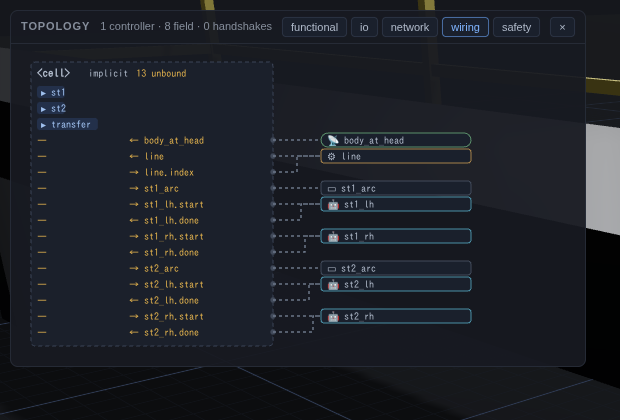
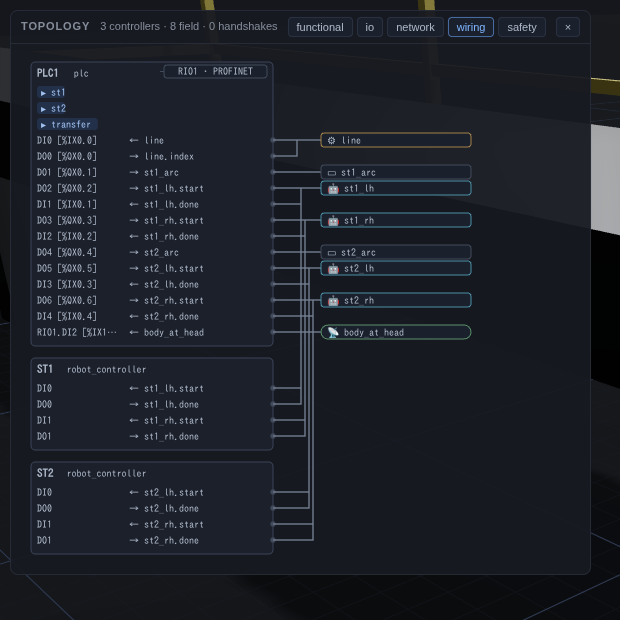
The studio's topology overlay draws
the same three placements — nothing declared (one dashed <cell> lane,
every row unbound), the PLC master with the arm handshakes wired to the
robots, and the stations on their own controllers with moving and
st*_done as buses between the lanes:
| 1 — nothing declared | 2 — PLC master, cabinets declared |
|---|---|
 |
 |
The tables
export_io_list(path) writes by extension:
.csv— one row per point, then#comment lines with the per-host point counts (# <cell>: DI 2, DO 3, Word 1)..md— the same as a Markdown table plus a count list..json— the raw fields (aspects, hosts, step indices), the form the other two are rendered from.
The columns are name, aspect, direction, kind, source, host, node,
channel, address, tag, field, contact, invert, safety, model, location,
writers, readers, status, note; the wiring columns fill in as points are
bound (node, channel and address from the binding's channel, tag / field /
contact / invert / note from the binding, model / location from the node).
Cosmetic rows sort last.
Faults: the fourth delta
A scenario so far varied the starting state — signal
initial values, obstacle poses, joint configurations. faults= pins an
input for the whole run:
scene.add_scenario("beam_stuck", faults=[bt.io.stuck("part_at_pick", False)])
scene.add_scenario("beam_open", faults=[bt.io.open("part_at_pick")])
scene.add_scenario("healthy", faults=[bt.io.stuck("estop_ok", True)])
runs = scene.simulate_scenarios(["pick"])
runs.errors
# {"beam_stuck": "timed out after 120s waiting in step 1 (`await part`) — forced: part_at_pick=false",
#  "beam_open":  "timed out after 120s waiting in step 1 (`await part`) — forced: part_at_pick=false"}
bt.io.stuck(name, value)— the contact is stuck: a sensor ignores its geometry, an internal signal drops everyseta program makes on it.bt.io.node_down(node)— a controller or a station dropped off the bus: every sensor or signal input wired on it (and on the stations uplinked to it) opens, each with its own binding's polarity — the communication loss of the I/O map, resolved through the bindings when the scenario is applied. Wire first; a node with nothing to open is refused rather than silently doing nothing.bt.io.open(name)— the wire is open: the input level is low, and the functional value is whatever the point's binding makes of a low level —Falseon a normally-open wiring,Trueon an inverted (invert=True, NC) one,Falsewhen nothing is bound. Whether the cell fails safe under a broken wire is exactly what the run then shows: an NC beam that reads "part present" forever, an edge-triggeredawait partthat still stalls (a pinned input is a level from t = 0, never an edge), an inverted E-stop healthy contact that stays healthy.
The target is a sensor or an internal signal — the things with an input
lane. A device's running lane is an output and cannot be forced; the DI a
device_done / robot_done wait reads has no lane of its own (an
in-position sensor's break is not expressible yet); open needs an input
wire, so a relay written and read on one controller is refused with a
pointer to stuck. Both hold from the first scan to the end — a scenario
never carries an absolute time; injection at a step or an edge is a later,
anchored form.
A run that stalls under a fault says so in the timeout's own sentence —
— forced: part_at_pick=false — collected in runs.errors next to the
scenarios that completed. Nothing else changes: a scenario without faults
bakes bit-identically to baseline, the live scene never carries a force,
and faults save with the project (generate_python writes them back as
bt.io.stuck(...) / bt.io.open(...)).
An E-stop, on this model, is a read-only internal signal (rule ④) that the
start, restart and interlock transitions AND into their conditions:
bt.seq.all_of(bt.seq.signal("estop_ok"), ...). safety_unread warns
when a declared safety input is read by nobody — the scenario that opens it
would then change nothing. What botrail checks is whether the programs
that should stop, stop; it does not model the safety chain cutting power
to a moving robot, and it does not claim a performance level.
Checking against the electrical sheet
The list the cell derives and the sheet the electrical designer keeps are two documents until one is checked against the other:
sheet = bt.io.read_io_list("electrical/pick_cell_io.csv")   # ours, or any CSV with a `name` column
d = bt.io.diff(scene, sheet)                                # or the path straight in
assert d.ok, d
IoDiff lists what the cell needs and the sheet lacks (added), what the
sheet still lists and the cell no longer derives (removed), and where a
wiring column disagrees (changed: (key, {"channel": ("DI2", "DI4")})).
Rows key on (name, aspect, direction) — plus host when the sheet
carries it — and only the wiring columns both sides have are compared
(node, channel, address, tag, field, contact, invert, kind, safety), so a
partial sheet with just names and channels checks just channels. str(d)
is the review note; bool(d) is "there are differences".
The handshake spec
The interface sheet between controllers — the one integrators keep by hand next to the PLC program — is a projection of the same derivation over a bake:
tl = scene.simulate_sequences(["st1", "st2", "transfer"])
tl.export_handshake_spec("line_handshake.md")     # or tl.handshake_spec() -> str
tl.robot_busy("st1_lh")                            # [(start, end), ...] merged moves
One block per line, and a summary table on top: handshake signals (rule ②
— written on one host, read on another; direction, both ends with node and
channel once bound, the steps that write and wait, the lane's high spans),
robot start / done / program handshakes (rule ⑥ — a robot driven from
another controller; the start pulses are the moves' issue times, the busy
spans the merged moves, done is the idle complement — a robot has no lane,
so the sheet synthesizes what its controller would show), and device
command / in-position lines (rule ⑤). Sensors and coils are field wiring
and stay in the I/O table. Per scenario it is the draft of the FAT I/O
test sheet; io=scene.io_map() labels a bake made before the wiring.
The weld line's third placement reads, in part:
| line | kind | from | to | writers | readers | activity |
|---|---|---|---|---|---|---|
| `moving` | signal | PLC1 · DO7 [%QX0.7] | ST1 · DI2; ST2 · DI2 | 10 | 18 | 5 pulse(s), 65.05 s high |
| `st1_done` | signal | ST1 · DO3 | PLC1 · DI6 [%IX0.6] | 5 | 3 | 3 pulse(s), 34.85 s high |
| `st2_done` | signal | ST2 · DO3 | PLC1 · DI7 [%IX0.7] | 5 | 3 | 3 pulse(s), 18.63 s high |
| `line` | device:done | line | PLC1 · DI1 [%IX0.1] | 0 | 5 | — |
| `line.index` | device:command | PLC1 · DO0 [%QX0.0] | line | 5 | 0 | 5 command(s) |
and the st1_done block shows the pulse the station raises and resets in
consecutive scans — 24.630–24.640 s — which is the kind of thing a PLC
programmer wants to know before the FAT, not during it.
The interlock table
The other sheet a control designer keeps by hand — what may not happen unless what — is a projection of the sequences themselves:
table = scene.interlocks()                     # or scene.interlocks(["vmc"])
table.rows[0]["condition"]                     # '(RISING(vmc/panel/cycle_start) AND vmc/side_door/closed AND …)'
scene.export_interlocks("cell_interlocks.md")  # .md / .csv / .json
One row per output a step switches — a signal written, a device
command, a robot motion or ramp started, a grasp or release — with the
condition that admits the step: the previous step's transition, an
arm's condition for the first step of a branch, the OR of the arms' exits
at a rejoin, and for a program's first step the cycle's last transition
(START OR …). Conditions read as ST over scene names — NOT mat,
RISING(vmc/panel/unclamp), INPOS(vmc/side_door), T >= 20 s,
DONE(enter), IDLE(arm). Every input the condition reads is classified
(sensor, signal, device lane, device, robot); a signal carries the
program/step that writes it, so a handshake between two controllers
reads across the table — the machine's cycle_start row names the
robot-side step that pressed the button, the robot's to_unclamp row the
machine's steps that drop running. Where the host has the point bound,
the row carries node.channel [address].
The table is derived, not typed: it cannot drift from the SFC the PLCopen
file carries or from the bake. botrail export --interlocks writes it
with the document set, and the machine tending
guide shows the three guards a machining centre's program is written
with — front door shut before the side door opens, the side door
confirmed shut and no E-stop before a start — as its rows.
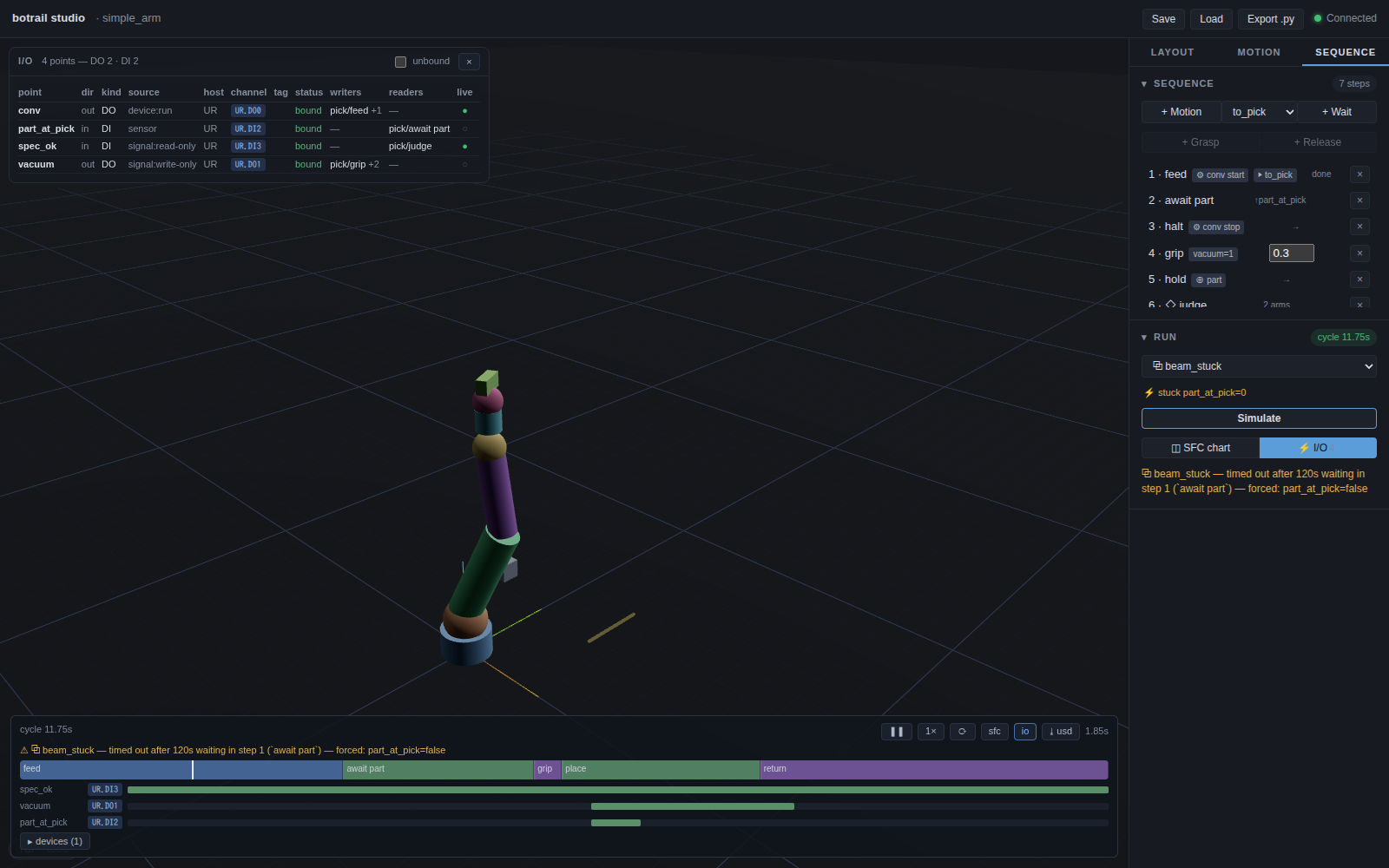
In the studio
The studio shows the same derivation live:
⚡ I/O overlays the table on the viewport (channels, findings, the
lane's level at the playhead), every timeline lane wears its channel chip,
the scene tree lists the I/O nodes, and a fault scenario picked in RUN
shows its forced inputs — a run under it that stalls leaves the last bake
on the dock and prints the diagnosis beside it. The assignment layer is
editable there too: a point's channel is a select over what its host
offers, auto-assign fills the rest, the footer declares points, and the
Layout inspector creates controllers and stations, places programs and
robots on them, sets uplinks and adds channel templates. Every edit is
validated the way the Python calls are and comes back through
generate_python as add_io_node / bind_input / declare_io.
Signal lanes know their kind
Baked lanes now say where they come from:
tl = scene.simulate_sequence("cycle")
tl.signal("eye").kind      # "sensor"
tl.signal("belt").kind     # "device"
tl.signal("seen").kind     # "signal"
That is the same classification the studio's timing chart groups its lanes by: device lanes start folded, sensor lanes fold once a cell has more than twelve, and each group has a chip to fold it in or out.